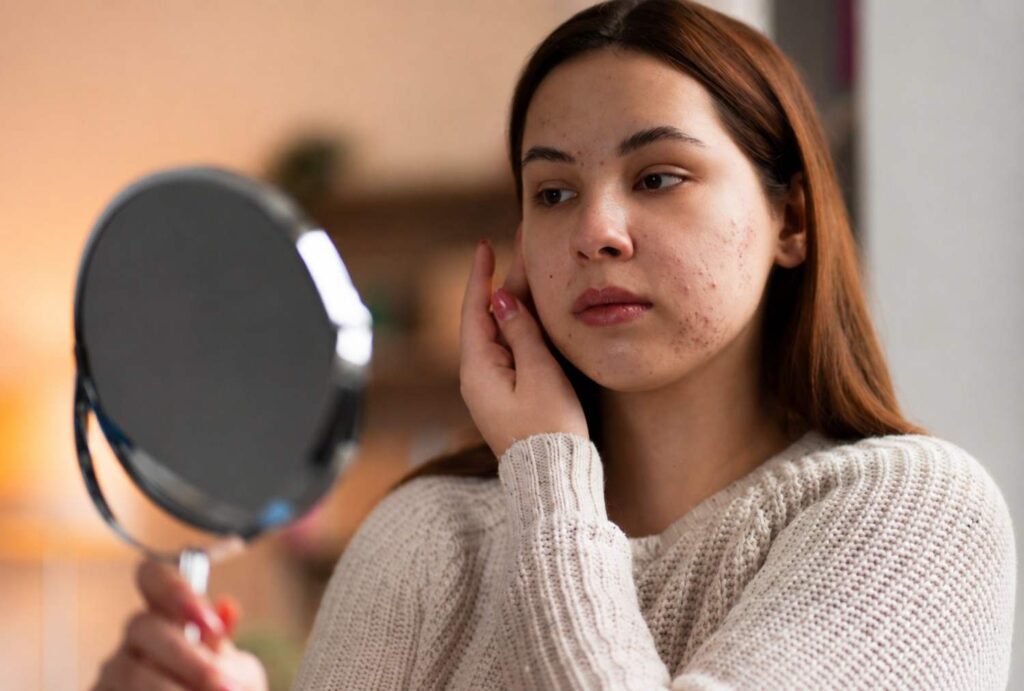
Why does my acne keep coming back? Recurring acne can happen because the underlying causes—such as clogged pores, excess oil, hormonal changes, inflammation, stress, irritating skincare products, or inconsistent treatment—are still present. Treating individual pimples may provide temporary relief, but preventing new breakouts usually requires a consistent, long-term acne management routine.
Why Does My Acne Keep Coming Back?
You finally get rid of your acne.
Your skin starts looking clearer. The painful bumps disappear. You feel like you’ve finally found a routine that works.
Then suddenly—another breakout appears.
Maybe it’s on your chin.
Maybe the same area of your jawline becomes inflamed again.
Or perhaps you wake up with several new pimples even though you haven’t changed anything in your skincare routine.
If you’ve ever searched “Why does my acne keep coming back?”, you’re definitely not the only one.
Recurring acne can be frustrating because it often feels like you’re starting from zero every time a new breakout appears. But there is an important distinction that many people miss:
Getting rid of a pimple is not always the same thing as preventing acne from forming again.
Acne develops through a combination of factors, including clogged pores, excess oil production, inflammation, bacteria, hormonal activity, genetics, and individual skin sensitivity. If those underlying factors remain, new breakouts can continue to appear even after previous pimples have healed.
The good news?
You don’t necessarily need a complicated 10-step skincare routine.
You need to understand what is repeatedly triggering your acne and build a strategy around that pattern.
In this guide, we’ll break down the most common reasons acne keeps coming back, how to identify your triggers, what skincare mistakes could be making the problem worse, and what you can do to reduce future breakouts.
What Is Recurring Acne?
Recurring acne is acne that repeatedly appears after previous breakouts have improved or disappeared. It can involve blackheads, whiteheads, inflammatory pimples, painful nodules, or breakouts concentrated in specific areas such as the chin, jawline, cheeks, forehead, or neck.
Recurring acne doesn’t necessarily mean your previous treatment “failed.”
Sometimes the treatment worked—but only temporarily.
Other times, the treatment was addressing one part of the problem while another trigger continued.
For example:
- Your acne medication may reduce inflammation.
- But hormonal changes may still trigger new breakouts.
- A treatment may clear clogged pores.
- But a pore-clogging product may continue creating new ones.
- Your skin may improve.
- But stopping treatment too early may allow acne to return.
That’s why acne management often needs to focus on prevention as well as treatment.
Why Does My Acne Keep Coming Back? 9 Possible Reasons
There isn’t one answer that applies to everyone.
However, several factors commonly contribute to recurring breakouts.
Let’s look at the biggest ones.
You’re Treating the Pimple Instead of the Acne-Prone Skin
This is one of the most common mistakes people make.
You notice a new pimple.
You apply a spot treatment.
The pimple becomes smaller.
A few days later, it disappears.
You stop using the treatment.
Then another pimple appears next to it.
The cycle repeats.
Why does this happen?
A visible pimple is only one part of the acne process.
Acne can begin developing underneath the skin before you actually see a noticeable breakout. If your skin is consistently prone to clogged pores and inflammation, treating only the pimples that have already appeared may not prevent new ones.
That’s why dermatologists often recommend applying appropriate acne treatments to the entire acne-prone area, rather than using medication only as an emergency spot treatment.
What should you do?
Instead of asking:
“How can I get rid of this pimple?”
Start asking:
“How can I prevent new pimples from forming?”
That small change in mindset can make your skincare approach much more effective.
A prevention-focused routine may include an appropriate acne treatment, gentle cleansing, moisturizer, and daily sunscreen.
The exact treatment depends on your acne type and skin sensitivity.
Hormonal Changes Could Be Triggering Your Acne
If your acne keeps returning around the chin, jawline, or lower face, hormones may be playing a role.
Hormonal acne is particularly common in adults, including people who never struggled with significant acne as teenagers.
Hormones called androgens can increase activity in the sebaceous glands. This can contribute to increased oil production and clogged pores.
Hormonal fluctuations can occur during:
- Menstrual cycles
- Puberty
- Pregnancy
- Perimenopause
- Menopause
- Starting or stopping hormonal birth control
- Other hormonal changes
For some people, the pattern is surprisingly predictable.
You may notice that your skin looks relatively clear for part of the month, followed by several pimples around your chin or jawline.
Then the acne improves.
And the same pattern happens again.
Signs your acne may have a hormonal component
Watch for patterns such as:
- Acne repeatedly appearing around your chin
- Breakouts along your jawline
- Deep or painful pimples
- Acne that worsens around your menstrual period
- Adult acne that suddenly becomes persistent
- Breakouts that don’t respond well to basic skincare
This doesn’t automatically mean your acne is hormonal.
But a consistent pattern is worth discussing with a dermatologist.
Can hormonal acne be treated?
Yes.
Depending on your individual situation, dermatologists may consider topical treatments or prescription hormonal options.
For some women, treatments such as certain oral contraceptives or spironolactone may be appropriate. These require professional evaluation because they aren’t suitable for everyone.
Don’t start prescription hormonal medication based solely on an online article.
You’re Stopping Your Acne Treatment Too Early
Here’s a frustrating truth about acne:
Most effective treatments don’t work overnight.
You use a product for three days.
Nothing dramatic happens.
You decide:
“This product doesn’t work.”
So you replace it.
Then you try another product.
Then another.
Eventually, your skin becomes irritated from constantly changing your routine.
This is one reason people can feel as though nothing works for their acne.
Acne treatment takes time
Many acne treatments require several weeks before noticeable improvement occurs.
The American Academy of Dermatology explains that people may need around 6 to 8 weeks to see improvement from an acne treatment, although achieving clearer skin can take longer.
That means patience matters.
If a treatment is appropriate for your skin, using it consistently is generally more useful than changing products every few days.
A better approach
When introducing an acne treatment:
- Follow the product directions.
- Introduce one major active at a time.
- Give your skin time to adjust.
- Monitor irritation.
- Don’t immediately add three more acne products.
- Reassess after several weeks rather than several days.
If your acne is getting significantly worse, painful, or severely irritated, speak with a healthcare professional instead of simply pushing through it.
Your Skincare Routine May Be Irritating Your Skin
When acne appears, it’s natural to think:
“I need to clean my skin more.”
So you wash your face repeatedly.
Then you scrub.
Then you use an exfoliating acid.
Then an acne serum.
Then another treatment.
It sounds logical.
But your skin isn’t a dirty surface that needs to be aggressively scrubbed clean.
Overdoing skincare can create another problem
Aggressive skincare may cause:
- Dryness
- Burning
- Redness
- Peeling
- Increased sensitivity
- Irritation
And once your skin becomes irritated, continuing to add strong products can make your routine harder to tolerate.
The American Academy of Dermatology recommends gentle cleansing and avoiding aggressive scrubbing for people with acne-prone skin.
Common signs your routine may be too aggressive
Your routine may need simplifying if your face frequently:
- Burns after applying products
- Feels extremely tight after cleansing
- Peels constantly
- Looks red or irritated
- Becomes unusually sensitive
- Stings when you apply moisturizer
Acne treatment shouldn’t feel like you’re punishing your skin.
The goal is to manage acne without unnecessarily damaging your skin barrier.
One of Your Skincare or Hair Products Could Be Contributing to Breakouts
Sometimes you blame your face wash when the real issue may be something else.
Think about everything that touches your face.
Your:
- Moisturizer
- Sunscreen
- Foundation
- Concealer
- Primer
- Makeup brushes
- Hair oil
- Hair gel
- Styling cream
- Conditioner
- Heavy facial oils
Some products can contribute to clogged pores in acne-prone individuals.
This is particularly important when you notice a pattern such as:
New product → new breakouts → stop product → skin improves.
That doesn’t prove the product caused the acne, but it’s a useful clue.
Look for non-comedogenic products
If you are prone to recurring acne, consider products labeled:
- Non-comedogenic
- Oil-free
- Won’t clog pores
The American Academy of Dermatology recommends looking for non-comedogenic products for acne-prone skin.
However, remember that every person’s skin is different.
A product can be labeled non-comedogenic and still not agree with your skin.
That’s why observing your own skin matters.
How to Identify What’s Actually Triggering Your Acne
Before buying another acne product, try something different:
Track your breakouts.
For the next few weeks, note:
Where does the acne appear?
- Forehead?
- Nose?
- Cheeks?
- Chin?
- Jawline?
- Neck?
When does it appear?
- After a stressful week?
- Around your period?
- After changing skincare?
- After wearing heavy makeup?
- After using a new hair product?
What type of acne is it?
- Tiny bumps?
- Blackheads?
- Whiteheads?
- Red pimples?
- Deep painful acne?
Patterns can provide useful information.
For example, recurring lower-face breakouts may suggest a hormonal component, while clusters of bumps around the hairline could make hair products worth examining.
The pattern isn’t a diagnosis—but it’s a useful starting point.
Why Does Acne Come Back in the Same Spot?
This is another question people frequently ask.
Why does my acne keep coming back in the same spot?
If a pimple repeatedly appears in the same general area, it may be because that area remains prone to clogged pores or inflammation.
But there can also be external triggers.
For example:
Chin and jawline
Hormonal fluctuations may play a role.
Forehead and hairline
Hair products, sweat, hats, or friction may contribute.
Cheeks
Makeup, phones, pillowcases, touching your face, or other forms of friction may be relevant.
Around the mouth
Some acne-like eruptions may actually represent another skin condition, so persistent or unusual bumps should be evaluated.
The important point is that location can provide clues, but it cannot diagnose the cause by itself.
Does Stress Make Acne Come Back?
Stress is another potential piece of the puzzle.
Stress doesn’t mean that you’re personally causing your acne.
However, research and dermatology guidance suggest that stress can worsen existing acne in some people.
Think about what happens during a stressful period:
You may sleep less.
You may touch your face more.
You may skip your normal skincare routine.
You may eat differently.
Your body may also undergo hormonal changes associated with stress.
All of these factors can potentially contribute to an acne flare.
What can help?
Don’t aim for a completely stress-free life—that isn’t realistic.
Instead:
- Maintain a regular sleep schedule.
- Exercise regularly.
- Take short breaks during stressful workdays.
- Practice breathing or relaxation exercises.
- Keep your skincare routine consistent.
- Avoid repeatedly checking or squeezing your skin.
Stress management should complement acne treatment, not replace it.
The Biggest Mistake: Constantly Chasing New Products
Social media makes acne treatment confusing.
One week, everyone recommends a particular serum.
The next week, it’s a new exfoliant.
Then a viral mask.
Then a “glass skin” routine.
Then a homemade remedy.
The result?
Your bathroom becomes a skincare laboratory.
And your skin becomes the experiment.
Here’s a better rule:
Don’t change your entire routine every time you see a new skincare trend.
If your routine is working and your skin is tolerating it, consistency may be more valuable than novelty.
Evidence-based acne treatment isn’t necessarily exciting.
Sometimes the most effective routine is actually the simplest one you can follow consistently.
What You Should Remember So Far
If your acne keeps coming back, don’t immediately assume that you need a stronger product.
First ask:
What’s causing the pattern?
Is it hormonal?
Are your pores repeatedly becoming clogged?
Are you irritating your skin?
Are you stopping treatment too soon?
Are your skincare or hair products contributing?
Is stress making existing acne worse?
Or could you be dealing with something that only looks like acne?
Once you identify the likely pattern, your next step becomes much clearer
You Stop Treatment As Soon As Your Skin Looks Clear
Imagine this:
You have been dealing with acne for months.
You finally find a routine that works.
Your pimples disappear.
Your skin looks smooth again.
So you stop using the products.
A few weeks later…
The acne comes back.
This can be incredibly frustrating, but it doesn’t necessarily mean your treatment failed.
Acne is often a chronic skin condition. Clearing existing breakouts does not automatically mean your skin is no longer acne-prone.
For some people, maintenance treatment is necessary to reduce the chance of new breakouts.
The American Academy of Dermatology notes that acne can return after treatment is stopped and that maintenance treatment may help prevent new breakouts.
Think prevention—not just treatment
There are two different goals:
Treatment:
Get existing acne under control.
Maintenance:
Help prevent new acne from forming.
If you only focus on the first goal, you may repeatedly find yourself starting over.
Certain Medications Can Make Acne Worse
Another possible reason your acne suddenly became persistent is a medication change.
Some medications are known to cause or worsen acne-like eruptions in certain people.
Examples can include medications containing:
- Corticosteroids
- Testosterone
- Lithium
Mayo Clinic lists certain medications among factors that may contribute to acne.
However, there is an important rule here:
Never stop a prescribed medication on your own.
If you noticed that your acne became significantly worse after starting a new medication, speak with the healthcare professional who prescribed it.
They can determine whether there is a connection and whether changing the treatment is appropriate.
What You Think Is Acne Might Be Something Else
This is one of the most overlooked reasons people struggle with “acne” for months or even years.
Not every bump on the face is acne.
Conditions such as folliculitis, perioral dermatitis, and other skin disorders can sometimes look similar to acne.
That matters because the treatment can be completely different.
For example, if you’re treating a non-acne condition with multiple acne products, you could irritate your skin without actually addressing the problem.
Signs you should get your skin evaluated
Consider seeing a dermatologist if:
- Your bumps are unusually itchy.
- Most bumps look almost identical.
- Your skin burns or stings frequently.
- The rash is concentrated around your mouth.
- Your acne suddenly changes.
- Your breakouts aren’t responding to appropriate treatment.
- You develop deep or painful lesions.
- You’re developing scars.
A correct diagnosis can save you from months of guessing.
You’re Picking, Squeezing, or Touching Your Face
Let’s be honest.
Almost everyone has done it.
You notice a whitehead.
You squeeze it.
It looks worse.
You squeeze it again.
Now there’s redness.
The next day, there’s a dark mark.
And then you’re wondering:
“Why does this acne spot keep coming back?”
Repeatedly touching or manipulating a breakout can increase inflammation and delay healing. Picking can also increase the risk of scarring and post-inflammatory hyperpigmentation.
If you’re tempted to squeeze a pimple
Try these alternatives:
- Leave it alone.
- Use your normal acne treatment.
- Use a clean hydrocolloid patch if appropriate.
- Keep your hands busy if touching your face is habitual.
- Avoid repeatedly checking the spot in the mirror.
Your goal isn’t to make every pimple disappear within an hour.
Your goal is to let the skin heal with as little additional inflammation as possible.
Why Does My Acne Keep Coming Back After I Stop Using Products?
This is one of the most important questions in recurring acne.
The answer is simple:
Many acne treatments control the processes that create acne; they don’t permanently remove your tendency to develop acne.
If your skin naturally produces more oil, clogs easily, or responds strongly to hormonal fluctuations, stopping an effective treatment may allow those processes to become active again.
This is why acne management is often more like ongoing maintenance than a one-time cure.
Think about it this way:
You don’t brush your teeth once and expect them to stay clean forever.
Likewise, if your skin is acne-prone, you may need a consistent preventive routine even after your skin becomes clear.
That doesn’t necessarily mean using aggressive treatments forever.
It means finding a sustainable routine that keeps your acne under control.
How to Prevent Acne From Coming Back
Now let’s move from the problem to the solution.
If your goal is to stop constantly dealing with new pimples, focus on these five principles:
Keep your routine consistent
Don’t constantly switch products.
Treat acne-prone areas
Don’t wait until every pimple appears.
Avoid unnecessary irritation
More active ingredients don’t automatically mean better results.
Protect your skin barrier
Moisturizer isn’t the enemy of acne-prone skin.
Give treatments enough time
Acne treatment requires patience.
A Simple Morning Routine for Acne-Prone Skin
You don’t need a complicated morning routine.
A practical routine can include four basic steps.
Gentle Cleanser
Use a gentle cleanser that removes excess oil, sweat, and makeup without leaving your skin extremely tight.
Avoid aggressively scrubbing your face.
Acne Treatment
Depending on your acne type, an appropriate treatment may include an ingredient such as:
- Benzoyl peroxide
- Salicylic acid
- Azelaic acid
- A topical retinoid
You don’t need to use all of them.
Choosing the right treatment is more important than collecting multiple actives.
Moisturizer
If acne treatment makes your skin dry, moisturizer becomes particularly important.
Look for a lightweight, non-comedogenic formula that your skin tolerates.
Skipping moisturizer because you have oily skin can sometimes make your routine unnecessarily uncomfortable.
Sunscreen
Finish with a broad-spectrum sunscreen.
Daily sun protection is particularly useful when you’re dealing with acne marks and discoloration because UV exposure can contribute to persistent pigmentation.
Choose a sunscreen that feels comfortable enough to use consistently.
A Simple Night Routine for Recurring Acne
Your nighttime routine doesn’t need to be complicated either.
Cleanse
Remove makeup, sunscreen, sweat, and accumulated oil.
Acne Treatment
Use your chosen acne treatment according to its directions.
Moisturizer
Finish with moisturizer to help support your skin barrier.
That’s it.
You don’t need to apply five different serums just because they’re trending online.
Which Acne Ingredients Actually Help?
Let’s break down the most common evidence-based ingredients.
Salicylic Acid
Salicylic acid is a beta hydroxy acid that can help unclog pores.
It is particularly useful for people dealing with:
- Blackheads
- Whiteheads
- Mild clogged pores
- Oily skin
But using higher concentrations or applying it too frequently isn’t automatically better.
If your skin becomes dry or irritated, reduce unnecessary exfoliation.
Benzoyl Peroxide
Benzoyl peroxide is a widely used acne treatment that helps reduce acne-causing bacteria and inflammation.
It is commonly used for inflammatory acne and can be particularly useful in combination with other acne treatments.
One important practical detail:
Benzoyl peroxide can bleach fabrics.
So don’t be surprised if your pillowcase or towel develops lighter spots after repeated exposure.
Adapalene and Topical Retinoids
Topical retinoids can help prevent clogged pores and are commonly used for acne treatment and maintenance.
Adapalene is one topical retinoid available over the counter in the United States.
Retinoids can initially cause dryness or irritation, especially when someone uses too much too quickly.
A common mistake is thinking:
“If a little helps, more must work faster.”
That’s not how acne treatment works.
Use the product according to its instructions and give your skin time to adjust.
Azelaic Acid
Azelaic acid is another useful option for acne-prone skin.
It can help with acne and may also be useful for the dark marks that remain after pimples heal.
This can make it particularly appealing for people dealing with both recurring acne and post-acne discoloration.
However, no ingredient works identically for everyone.
Your skin type, acne severity, sensitivity, and other products all matter.
How Long Does Acne Treatment Take to Work?
This is where expectations matter.
You shouldn’t expect a major transformation in three days.
For many acne treatments, noticeable improvement can take several weeks.
The American Academy of Dermatology recommends giving acne treatments adequate time to work rather than constantly switching products.
A useful way to think about progress is:
Week 1
Your main goal is tolerance.
Is your skin becoming excessively dry, irritated, or uncomfortable?
Weeks 2–4
You may start noticing changes, although acne can still be present.
Weeks 4–8
This is when some people begin seeing more meaningful improvement.
Beyond 8 weeks
If your acne isn’t improving despite consistent, appropriate treatment, it’s worth reassessing your approach with a healthcare professional.
This isn’t a strict timeline for everyone.
Some people improve faster.
Others need longer or require prescription treatment.
The 7-Day Acne Reset Strategy
Let’s be clear:
Seven days cannot permanently cure recurring acne.
But one week can help you remove unnecessary triggers and establish a more consistent routine.
Stop the Product Overload
Look at everything you’re putting on your face.
Remove unnecessary products from your routine.
Don’t introduce another viral serum.
Keep things simple.
Clean Your Makeup Tools
If you use makeup brushes or sponges regularly, clean them properly.
Also avoid sharing makeup or makeup tools with other people.
Stop Touching Your Face
Notice how often your hands touch your chin, cheeks, or forehead.
You may be surprised.
Make a conscious effort to keep your hands away from your face.
Check Your Hair Products
Do you use:
- Hair oil?
- Leave-in conditioner?
- Styling cream?
- Hair spray?
- Gel?
If these products frequently contact your forehead, cheeks, or pillowcase, pay attention to whether your breakouts follow that exposure.
Review Your Acne Pattern
Write down:
Where → When → What type → Possible trigger
Example:
Chin → Before period → Deep pimples → Possible hormonal pattern
This isn’t a diagnosis, but it gives you useful information.
Prioritize Sleep and Stress Management
Don’t underestimate basic habits.
Aim for a consistent sleep schedule and take some time away from screens and work.
You don’t need to completely eliminate stress.
Just create opportunities for your body and mind to recover.
Common Mistakes That Make Recurring Acne Worse
Even with good intentions, some habits can keep acne going.
Washing Your Face Too Often
Acne isn’t caused by simply having a dirty face.
Overwashing can irritate the skin.
A gentle cleansing routine is generally better than repeatedly scrubbing your face.
Using Too Many Active Ingredients
Imagine using:
Salicylic acid + retinoid + benzoyl peroxide + exfoliating toner + acne serum
all at once.
That’s not necessarily a stronger acne routine.
It may simply be a more irritating one.
Changing Products Every Week
Give an appropriate treatment time to work.
Constant experimentation makes it difficult to determine what actually helps your skin.
Popping Pimples
It may feel satisfying for 30 seconds.
The dark mark can last much longer.
Ignoring Moisturizer
Acne-prone skin can still need hydration.
Look for a moisturizer that is lightweight and non-comedogenic.
Does Your Pillowcase Cause Acne?
You may have heard that dirty pillowcases are responsible for acne.
The reality is more nuanced.
Your pillowcase can collect oil, sweat, skincare products, makeup residue, and hair products.
Keeping bedding reasonably clean is sensible hygiene, but changing your pillowcase every single day isn’t necessarily the magic solution to recurring acne.
If your acne continues despite clean bedding, don’t assume your pillowcase is the root cause.
Look at the bigger picture.
Can Hair Products Cause Forehead Acne?
Yes, hair products can contribute to breakouts in some people.
This is sometimes called pomade acne, where oily or pore-clogging hair products contribute to bumps around the hairline and forehead.
If you notice small bumps around your hairline, examine:
- Hair oils
- Pomades
- Styling creams
- Leave-in conditioners
- Hair gels
- Heavy conditioners
Try keeping these products away from your facial skin and observe whether the pattern changes.
When Should You Stop Treating Acne Yourself?
Over-the-counter products can be useful for mild acne.
But there comes a point when repeatedly experimenting at home isn’t the best strategy.
Consider seeing a dermatologist if:
Your acne is painful
Deep, painful acne may require prescription treatment.
You’re developing scars
Don’t wait until significant scarring has occurred.
Your acne is persistent
If you’ve consistently followed an appropriate routine and aren’t seeing meaningful improvement, professional evaluation makes sense.
Your acne is affecting your mental health
Acne isn’t “just cosmetic.”
Persistent breakouts can affect confidence, social life, and emotional well-being.
You deserve treatment that takes those concerns seriously.
You’re unsure whether it’s actually acne
A dermatologist can distinguish acne from other acne-like conditions.
How Do Dermatologists Treat Acne That Keeps Coming Back?
When acne is persistent, a dermatologist doesn’t simply look at the biggest pimple on your face.
They consider the overall pattern.
A dermatologist may evaluate:
- Where your acne appears
- How long you’ve had it
- Whether it is hormonal
- Whether your acne is inflammatory
- Whether you’re developing scars
- Which treatments you’ve already tried
- How your skin responds to products
- Whether medications could be contributing
- Whether another skin condition could look like acne
This is important because recurring acne doesn’t look the same in everyone.
Someone with occasional blackheads may need a very different approach from someone with deep, painful nodules.
Over-the-Counter vs. Prescription Acne Treatment
One of the most common questions is:
“Do I need prescription acne treatment, or can I manage recurring acne myself?”
The answer depends on the severity and type of acne.
| Treatment approach | Often used for | Important consideration |
| Salicylic acid | Blackheads, whiteheads, clogged pores | Can irritate if overused |
| Benzoyl peroxide | Inflammatory pimples | Can cause dryness and bleach fabrics |
| Adapalene | Comedonal and inflammatory acne | Requires consistent use |
| Azelaic acid | Acne and post-acne marks | Generally useful for several acne concerns |
| Prescription topical retinoids | Persistent acne | Dermatologist guidance may be appropriate |
| Oral antibiotics | Certain moderate-to-severe cases | Usually used under medical supervision |
| Hormonal treatments | Hormonal acne in appropriate patients | Requires individual evaluation |
| Isotretinoin | Severe or treatment-resistant acne | Requires close medical supervision |
The American Academy of Dermatology’s acne guidelines include topical therapies, systemic treatments, hormonal therapies for appropriate patients, and isotretinoin for severe acne or acne that has not responded adequately to standard treatment.
The important takeaway is simple:
Stronger doesn’t always mean better.
The best treatment is the one that matches your specific type and severity of acne.
What About Isotretinoin?
If you’ve searched for treatments for severe acne, you’ve probably heard of isotretinoin.
It is a powerful prescription treatment used for severe acne and certain cases that haven’t responded adequately to other therapies.
However, isotretinoin isn’t a casual skincare product.
It requires medical supervision because it can have significant side effects and safety considerations.
If you have:
- Severe nodular acne
- Significant acne scarring
- Acne that hasn’t responded to appropriate treatment
- Acne that is seriously affecting your quality of life
a dermatologist may discuss whether isotretinoin is appropriate.
Don’t purchase or use prescription acne medication from unverified online sources.
How to Prevent Acne Scars and Dark Spots
There’s another reason recurring acne becomes frustrating:
Even after the pimple disappears, the mark stays behind.
You may be left with:
- Red or pink marks
- Brown or dark spots
- Uneven skin tone
- Textural scars
These marks are often more noticeable in people with medium to deep skin tones.
The best strategy is prevention.
Don’t pick your pimples
Picking increases inflammation and can increase the risk of scarring.
Treat acne early
Persistent inflammatory acne can increase the likelihood of long-lasting marks and scars.
Use sunscreen
Daily broad-spectrum sunscreen can help protect your skin and prevent existing pigmentation from becoming more noticeable.
Don’t over-exfoliate
Trying to scrub away dark marks can irritate your skin and potentially make the problem worse.
If you’re developing significant acne scars, a dermatologist can discuss treatment options after your active acne is under control.
Acne Scars vs. Acne Dark Spots: What’s the Difference?
People often use the words interchangeably, but they aren’t the same thing.
Acne Dark Spots
These are areas of pigmentation left behind after inflammation.
They can gradually fade over time.
Acne Scars
True scars involve changes in the skin’s texture.
Examples include:
- Depressed scars
- Ice-pick scars
- Boxcar scars
- Raised scars
Skincare products may help improve some discoloration, but deeper textural scars often require professional procedures.
That’s why preventing severe acne and avoiding picking are so important.
What Is the Best Skincare Routine for Recurring Acne?
Let’s simplify everything.
You don’t need 12 products.
A basic routine can be:
Morning
1. Gentle cleanser
Remove excess oil and sweat without aggressively scrubbing.
2. Acne treatment, if appropriate
Choose an evidence-based treatment that matches your acne.
3. Moisturizer
Use a lightweight, non-comedogenic formula.
4. Broad-spectrum sunscreen
Aim for SPF 30 or higher and choose one you can comfortably wear every day.
Night
1. Gentle cleanser
Remove makeup, sunscreen, sweat, and buildup.
2. Acne treatment
Use your chosen treatment according to directions.
3. Moisturizer
Help keep your skin comfortable and support your skin barrier.
That’s enough for many people.
You can add additional products if there is a specific reason for doing so—but don’t assume more steps equal better results.
Expert Tips for Preventing Recurring Acne
Take photos
Take a clear photo of your skin once a week under similar lighting.
Don’t take 20 photos every day.
Weekly comparisons make it easier to notice gradual changes.
Introduce one major change at a time
If you suddenly add four new products and your skin improves—or gets worse—you won’t know which product caused the change.
One change at a time gives you better information.
Treat your acne before it becomes severe
Don’t wait until you’re developing painful cysts before seeking professional help.
Early treatment can reduce inflammation and may reduce the risk of scarring.
Don’t confuse irritation with purging
This is an important distinction.
Some acne treatments can cause temporary irritation or an initial increase in breakouts in certain situations.
But severe burning, swelling, intense redness, or worsening irritation isn’t something you should simply ignore.
If you’re unsure whether your reaction is expected, speak with a dermatologist or healthcare professional.
Be suspicious of miracle claims
If someone promises:
“Clear acne overnight.”
Be skeptical.
Acne is a complex skin condition.
A realistic treatment strategy focuses on gradual improvement, prevention, and consistency—not overnight transformations.
Frequently Asked Questions
Conclusion
If you’ve been asking “Why does my acne keep coming back?”, the answer is rarely as simple as needing a stronger face wash.
Recurring acne is often a combination of your skin’s natural tendency to clog, hormonal changes, inflammation, lifestyle factors, product choices, and treatment consistency.
The solution is to identify the pattern instead of constantly reacting to individual pimples.
Start with a gentle routine.
Choose evidence-based acne treatment.
Give it enough time.
Avoid picking.
Use non-comedogenic products.
Protect your skin from the sun.
Pay attention to hormonal and lifestyle patterns.
And if your acne is painful, persistent, scarring, or not improving, don’t spend another year experimenting on your own.
Talk to a dermatologist and get a personalized treatment plan.
Clearer skin isn’t about finding the perfect viral product.
It’s about finding what works for your skin—and staying consistent long enough to see the difference.
Disclaimer
This article is for educational and informational purposes only. It is not a substitute for professional medical advice, diagnosis, or treatment. Acne can have different causes and may require individualized care. If you have severe, painful, persistent, or scarring acne, or if you’re unsure whether your skin condition is actually acne, consult a qualified dermatologist or healthcare professional.