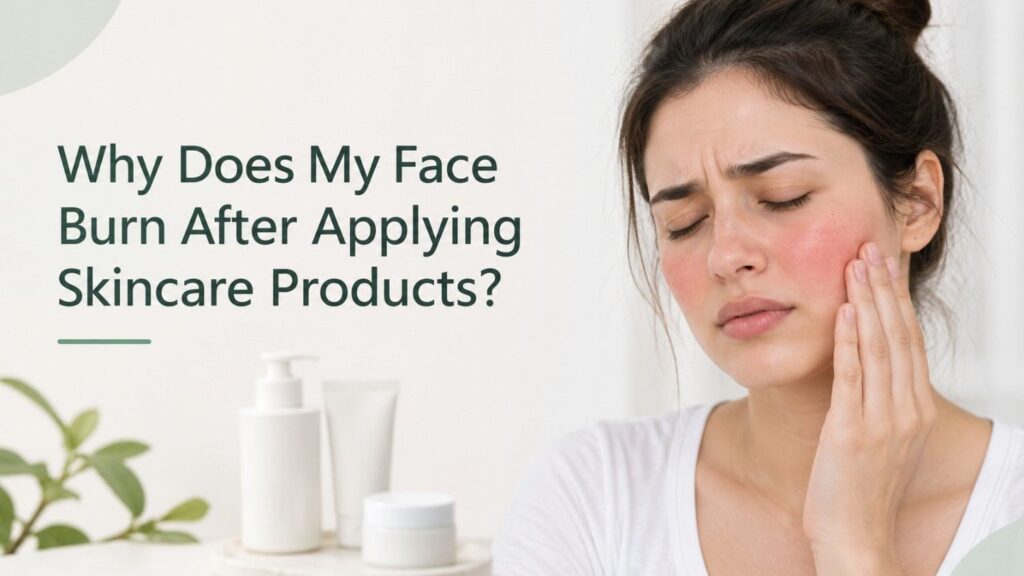
Have you ever applied your favorite moisturizer, serum, or cleanser and suddenly felt a burning sensation on your face? Your skin may feel hot, sting, turn red, or become uncomfortable even when you are using products designed for everyday skincare.
This experience can be confusing, especially if you have used the same product for weeks or months without any problems. However, burning after applying skincare products can happen for several reasons, including irritation, sensitivity to ingredients, over-exfoliation, or an underlying skin condition.
Skincare should not cause persistent burning or significant discomfort. Although some active ingredients can cause mild, temporary tingling, a strong or lasting burning sensation should not be ignored.
In this guide, you will learn why your face may burn after applying skincare products, what you should do when it happens, which ingredients may contribute to irritation, and how to build a gentler skincare routine.
Why Does My Face Burn After Applying Skincare Products?
Your face may burn because a product contains an ingredient that irritates your skin, your skin barrier is compromised, or you are experiencing an allergic reaction. Sometimes, several factors contribute to the problem.
The sensation alone cannot identify the exact cause. Pay attention to other symptoms, including redness, itching, swelling, dryness, peeling, or a rash.
Let’s explore seven possible reasons.
1. Your Skin Barrier May Be Damaged
Your skin barrier is the outermost protective layer of your skin. It helps retain moisture and protects against irritants and other environmental factors.
When this barrier becomes disrupted, your skin may lose moisture more easily and become more sensitive to products that previously felt comfortable.
Common signs of a compromised skin barrier include:
- Dryness, tightness, or rough skin.
- Redness or increased sensitivity.
- Flaking or peeling.
- Stinging when applying moisturizer.
- Discomfort after washing your face.
Over-exfoliation, harsh cleansers, frequent washing, and using several strong active ingredients may contribute to irritation.
What can you do?
Temporarily stop exfoliating acids, retinoids, scrubs, and other products that appear to trigger the burning. Use a gentle cleanser, if tolerated, and a simple moisturizer without fragrance.
Avoid adding multiple new products while your skin is irritated. If symptoms persist or worsen, consult a dermatologist.
2. Your Skincare Products May Contain Irritating Ingredients
Not every ingredient suits every person’s skin. Some ingredients can cause irritation, particularly when used too frequently, at high concentrations, or alongside other irritating products.
Ingredients and product types that may contribute to irritation include:
- Alpha hydroxy acids (AHAs): Glycolic acid and lactic acid can cause irritation, especially with excessive use.
- Retinoids: Retinol and certain prescription retinoids may cause dryness, peeling, and irritation.
- Benzoyl peroxide: This acne treatment can cause dryness, redness, and burning in some people.
- Fragrance: Fragrance ingredients can trigger irritation or allergic contact dermatitis in susceptible individuals.
- Strong cleansing products: Some cleansers can strip away skin oils and leave the skin feeling dry or uncomfortable.
Vitamin C products and other concentrated treatments may also irritate some users.
This does not mean that every ingredient listed above is harmful or unsuitable for everyone. The concentration, formulation, frequency of use, and condition of your skin all matter.
What should you do?
Review the ingredients in the product that caused the reaction. Stop using it if it produces persistent burning or other signs of irritation.
Once your skin has settled, introduce products cautiously and avoid starting several active ingredients at once. If the same reaction keeps occurring, a dermatologist can help identify the trigger.
3. You May Be Over-Exfoliating Your Skin
Exfoliation helps remove dead skin cells, but excessive exfoliation can leave your skin irritated and uncomfortable.
This may happen if you frequently use exfoliating toners, chemical peels, facial scrubs, acne treatments, or multiple products containing active ingredients.
You might notice:
- Burning when applying moisturizer.
- Redness after cleansing.
- Unusual dryness or peeling.
- Increased sensitivity to sunlight or other products.
- Skin that feels tight or sore.
Using more products does not necessarily produce better results. An aggressive routine may make existing skin concerns harder to manage.
How to avoid over-exfoliation
Pause exfoliating products while your skin is irritated. Avoid scrubbing, peeling treatments, and unnecessary active ingredients until your skin has recovered.
When appropriate, reintroduce products gradually and follow their directions. If irritation returns, discontinue the triggering product and seek professional advice.
4. You May Have Sensitive Skin
Sensitive skin can react more easily to particular skincare ingredients, environmental conditions, or changes in your routine.
People with sensitive skin may experience stinging, itching, redness, or a burning sensation after applying cleansers, moisturizers, sunscreens, or serums.
However, sensitive skin is not the only possible explanation. Conditions such as eczema and rosacea can also make the face more reactive.
How to care for sensitive skin
Choose simple, fragrance-free products and introduce them one at a time. Avoid rough scrubs, harsh cleansing, and unnecessary exfoliation.
If you want more guidance, read our article on cruelty-free skincare for sensitive skin for additional product-selection considerations.
Remember that a product labelled “sensitive-skin friendly” is not guaranteed to suit everyone. Your individual triggers still matter.
5. You May Be Experiencing an Allergic Reaction
Sometimes, burning is part of a condition called allergic contact dermatitis. This occurs when your immune system reacts to a substance that touches your skin.
Unlike simple irritation, an allergic reaction may involve itching, a rash, swelling, or blisters. Symptoms can appear after you have used a product more than once without problems.
Possible triggers include fragrance ingredients, preservatives, and certain botanical extracts.
It is also important to understand that irritation and allergy are different. They can produce similar symptoms, and you may not be able to distinguish them at home.
What should you do?
Stop using the suspected product and gently rinse it off if it is still on your skin.
Avoid experimenting with other new products to cover up the reaction. If symptoms persist, recur, or involve a rash or swelling, contact a healthcare professional. A dermatologist may recommend patch testing to identify an allergy.
Do not deliberately reapply a product to test whether it causes another reaction.
6. Your Moisturizer May Not Suit Your Skin
Moisturizers are designed to support hydration and reduce moisture loss, but not every formulation works well for every person.
A moisturizer may sting if your skin is already irritated or if you are sensitive to one of its ingredients. Applying it immediately after aggressive cleansing or exfoliation may also make discomfort more noticeable.
Your skin type can influence which formulation feels most comfortable.
For example, people with dry skin may prefer a richer cream, while those with oily skin may find a lightweight lotion or gel more comfortable.
If you have dry skin, you may also find our guide to skin care for dry skin helpful when choosing products for your routine.
How to choose a moisturizer
Look for a simple, fragrance-free formulation that your skin tolerates. Ingredients such as glycerin and ceramides can help support hydration and the skin barrier.
If a moisturizer repeatedly causes burning, redness, or itching, stop using it rather than forcing your skin to adjust.
If nearly every moisturizer stings, consider getting your skin assessed by a dermatologist.
7. An Underlying Skin Condition May Be Responsible
Sometimes, the problem is not a particular skincare product. An underlying skin condition may make your face more sensitive to everyday ingredients.
Two possible examples are:
Rosacea: This condition can cause facial redness, flushing, visible blood vessels, and sometimes acne-like bumps. People with rosacea may find that certain skincare products trigger stinging or burning.
Eczema: Eczema can cause dry, itchy, inflamed skin. Products that would otherwise feel comfortable may sting when the skin is inflamed or cracked.
Other skin conditions can also cause facial redness or discomfort, so symptoms alone are not enough to establish a diagnosis.
When should you seek medical advice?
Consider consulting a dermatologist if your face burns repeatedly, redness does not improve, a rash develops, or ordinary skincare products become difficult to tolerate.
Seek urgent medical care if you experience severe facial swelling, blistering, significant pain, or symptoms involving your eyes. If you develop difficulty breathing or swelling of your tongue or throat, seek emergency medical help immediately.
What Should You Do Immediately When Your Face Starts Burning?
If your face starts burning after applying a skincare product, take the following steps.
Step 1: Stop applying the product
Do not add more product or continue rubbing it into your skin. If the burning is significant or persistent, do not assume that it is a normal part of the treatment.
Step 2: Gently rinse your face
If the product is still on your skin, rinse it off with lukewarm water. Avoid hot water, vigorous rubbing, and harsh cleansers.
Step 3: Use a cool compress
Place a clean, cool, damp cloth on the affected area for a short period. Avoid applying ice directly to your skin.
Step 4: Keep your routine simple
For the moment, avoid exfoliating acids, retinoids, facial scrubs, fragranced products, and other treatments that may worsen irritation.
If tolerated, use a simple moisturizer. A thin layer of plain petroleum jelly may help protect some areas of irritated skin, but it is not suitable for every situation. Avoid applying it over a product that has not been rinsed off.
Step 5: Monitor your symptoms
Pay attention to whether the burning improves after rinsing and avoiding the suspected product.
Get medical advice if symptoms are severe, continue, worsen, or repeatedly return. Do not rely on home remedies to treat a significant reaction.
How to Prevent Your Face From Burning After Skincare
A few practical habits can help reduce the risk of irritation.
| Skincare habit | Why it helps |
|---|---|
| Introduce one new product at a time | Makes it easier to identify a possible trigger |
| Patch-test new products | Helps identify some potential reactions before facial use |
| Avoid excessive exfoliation | Reduces the risk of irritation |
| Choose fragrance-free products when sensitive | Helps avoid some common fragrance-related triggers |
| Use a gentle cleanser | Reduces unnecessary friction and cleansing-related irritation |
| Follow product directions | Helps prevent excessive or inappropriate use |
| Keep a record of reactions | Helps you identify products or ingredients that may be responsible |
Patch-test new products
The American Academy of Dermatology recommends testing a new skincare product on a small area of skin twice daily for seven to ten days, following the product’s normal application instructions.
If redness, itching, swelling, or another reaction develops, wash the product off and do not continue testing it.
A home patch test cannot rule out every possible reaction, and it should not be used to test a product again after a significant reaction. If you have a history of severe allergies, discuss product testing with a healthcare professional.
Does Burning Mean a Skincare Product Is Working?
No. Burning does not automatically mean a product is effective.
Some active ingredients can cause mild irritation, particularly when first introduced. However, persistent burning, significant redness, swelling, or pain should not be treated as proof that a product is working.
A stronger sensation does not necessarily mean better results.
If a product repeatedly burns your face, stop using it and reassess whether it is appropriate for your skin. For prescription treatments, ask your prescribing clinician how to proceed.
Can You Apply Moisturizer to Burning Skin?
It depends on the cause and severity of the reaction.
A gentle moisturizer may help if your skin feels dry or irritated, but some formulations can sting when the skin barrier is compromised.
If your face starts burning after applying moisturizer, rinse it off if the discomfort is persistent, and avoid reapplying the same product until you understand what caused the reaction.
Choose a simple, fragrance-free formulation once your skin can tolerate it. If even basic moisturizers cause repeated burning, seek advice from a dermatologist.
Is Burning After Skincare a Sign of a Damaged Skin Barrier?
It can be, but burning alone does not confirm a damaged skin barrier.
A compromised barrier may also cause dryness, tightness, peeling, redness, and increased sensitivity to products. Over-exfoliation and harsh cleansing can contribute to these symptoms.
However, allergic contact dermatitis, rosacea, eczema, and other conditions can produce similar discomfort.
If your symptoms continue despite simplifying your routine, a dermatologist can help determine the underlying cause.
Frequently Asked Questions
Final Thoughts
If your face burns after applying skincare products, do not ignore the sensation or assume that it means your routine is working.
The cause may be irritation from active ingredients, excessive exfoliation, a compromised skin barrier, an allergic reaction, or an underlying skin condition. The best approach is to stop the suspected trigger, keep your routine gentle, and monitor your symptoms.
Choose products based on your skin’s needs rather than the number of steps in your routine. Introduce new products cautiously and seek professional advice when burning is persistent, severe, or accompanied by other concerning symptoms.
Healthy skincare is about protecting your skin and using products it can tolerate—not pushing through discomfort.
Medical disclaimer: This article is for general educational purposes only and does not replace professional medical advice, diagnosis, or treatment. Consult a qualified healthcare professional for persistent or severe skin symptoms.
References
- American Academy of Dermatology: How to Test Skin Care Products
- American Academy of Dermatology: 10 Reasons Your Face Is Red
- American Academy of Dermatology: Rosacea Skin Care Tips